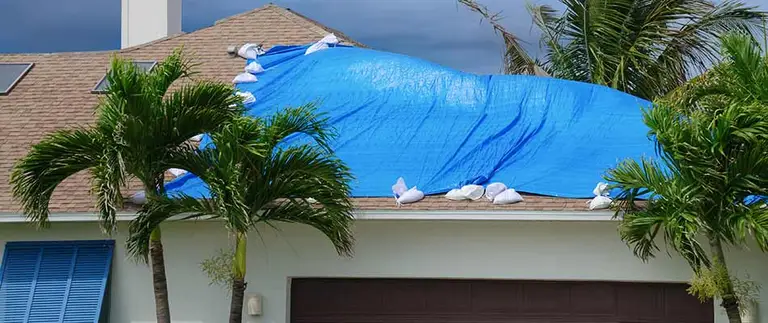
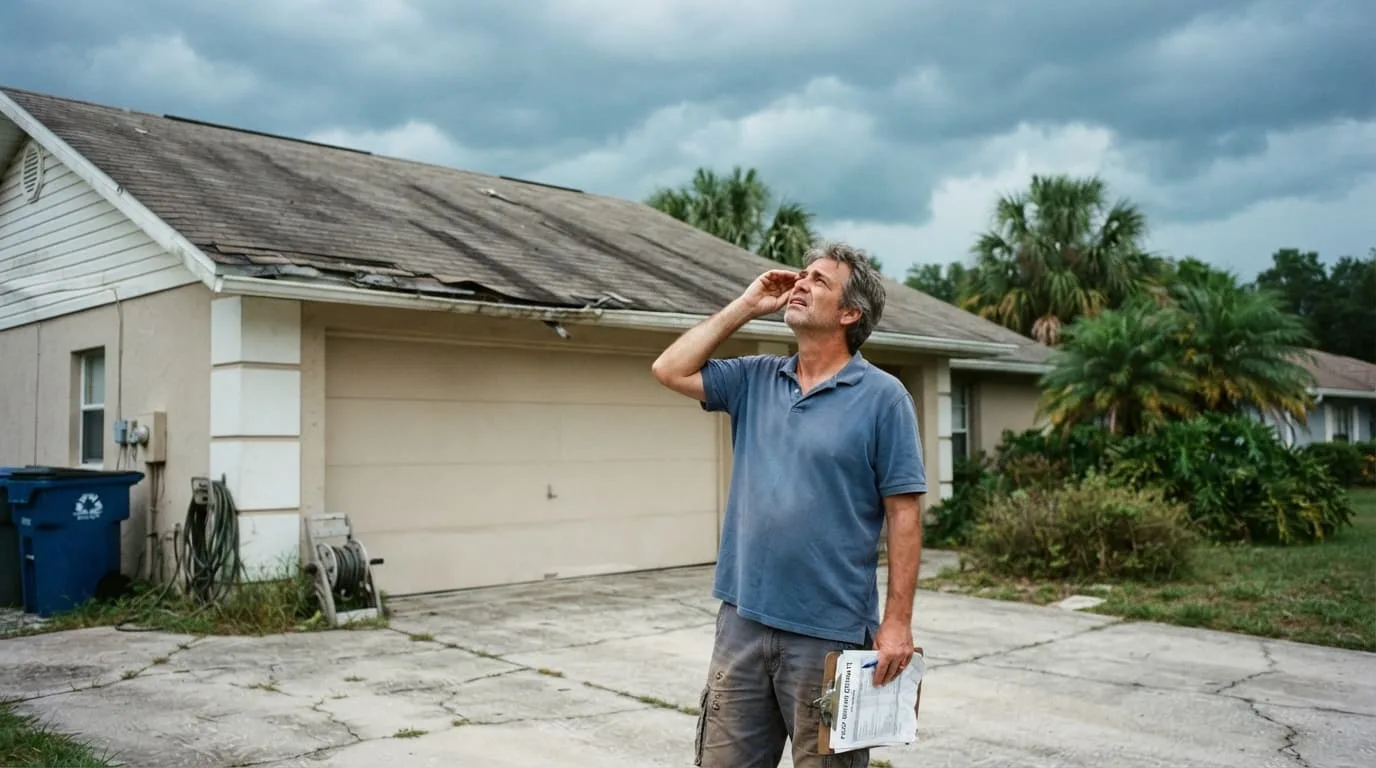
After storm damage, Lakeland homeowners should ask a roofing contractor what failed, what repairs are required, what evidence supports the claim, and whether the proposed work meets Florida code. Florida’s average homeowners insurance premium reached $8,292 in 2025, according to Insurify, which makes every repair decision more consequential. This guide explains the data behind Florida’s insurance repair gap and the questions to ask before signing a roofing contract.
A shorter version is Lakeland Storm Damage: What to Ask a Roofing Contractor.
Key statistics on Florida’s insurance repair gap
These figures show why storm-damaged homeowners need clear documentation, realistic repair estimates, and a careful understanding of the difference between roof damage and insurance coverage.
- $8,292. Insurify’s Florida Home Insurance Report. Florida’s average annual homeowners insurance premium in 2025.
- Nearly 3x the national average ($2,948). Insurify’s national home insurance data. How far Florida’s average premium sits above the U.S. average.
- 18% jump. Insurify’s Florida report. The increase in Florida’s average premium from 2024 to 2025.
- 40.3% (up from 35.3% in 2022). Claims Journal analysis of insurer data. The share of Florida private-insurer claims closed without payment in 2024.
- 45%. University of North Florida poll. Among the 261 surveyed homeowners who filed claims in the previous five years, 45% said their claim was initially denied.
- 63% vs. 36%. University of North Florida Public Opinion Research Lab. More surveyed homeowners identified property insurance as a greater concern than property taxes.
- 129 vs. about 11 per 1,000. Weiss Ratings analysis of NAIC data. The difference in lawsuit frequency tied to denied claims.
- 15% increase (124 in 2022 to 143 in 2025). Weiss Ratings data. The increase in Florida lawsuits per 1,000 denied claims.
- $8,000 to $30,000 (asphalt: $12,000 to $15,000 mid-range). Central Florida contractor pricing. A directional range for roof replacement costs, not a statewide price index.
- $6,000 to $15,000 (2% to 5% of insured value). Florida hurricane deductible range on a $300,000 insured home. Florida’s Department of Financial Services confirms that many policies use a 2% to 5% hurricane deductible.
Why is Florida’s average annual insurance premium $8,292?
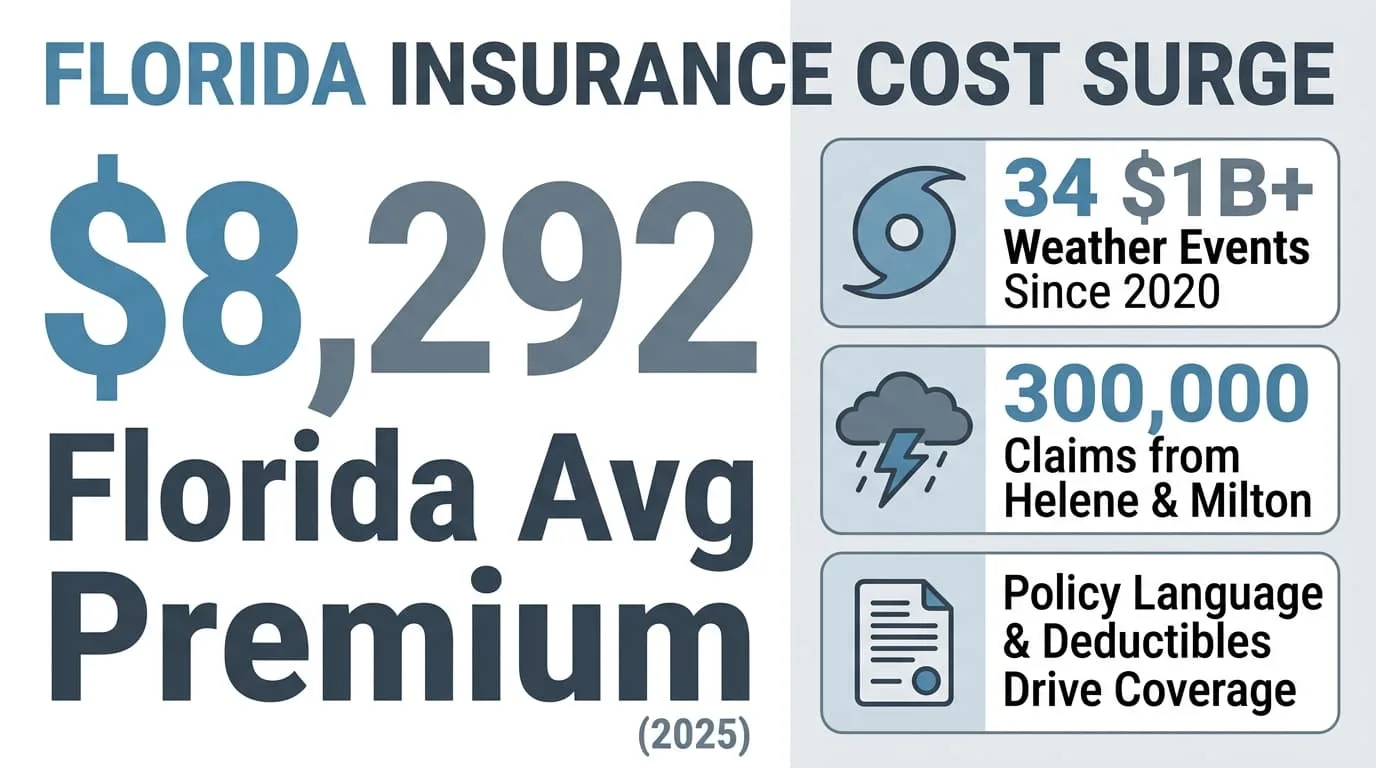
Florida’s average annual homeowners insurance premium reached $8,292 in 2025, making insurance cost a major part of the financial equation after roof damage. Insurify reported the figure in its 2026 Florida home insurance report.
Florida’s exposure to hurricanes and other severe weather helps explain the pricing. Using National Oceanic and Atmospheric Administration data, Insurify reported approximately 34 billion-dollar weather events in Florida since 2020, including severe storms, floods, and tropical cyclones.
The 2024 hurricane season also affected the following year’s pricing. Insurify reported approximately 300,000 home insurance claims after Hurricanes Helene and Milton, and those losses contributed to higher 2025 premiums.
For a Lakeland homeowner, the premium does not determine whether a roof claim will be covered. The policy language, cause of loss, deductible, exclusions, roof condition, and documentation all matter.
A storm inspection should therefore answer more than whether shingles are missing. It should establish what damage exists and whether it appears consistent with the reported weather event. Ask your roofing contractor:
- What specific roof components were damaged?
- Is the damage consistent with wind, hail, falling debris, or another event?
- Are there signs of pre-existing deterioration?
- What temporary repairs are needed?
- What photographs and written findings will be provided?
A licensed roofing contractor such as True Roofers can document roof conditions, while the homeowner remains responsible for reporting the claim to the insurer. True Roofers lists Florida roofing license CCC1332725 and provides photo documentation and written condition reports. We do not file or adjust claims.
Why is Florida’s premium nearly 3x the $2,948 national average?
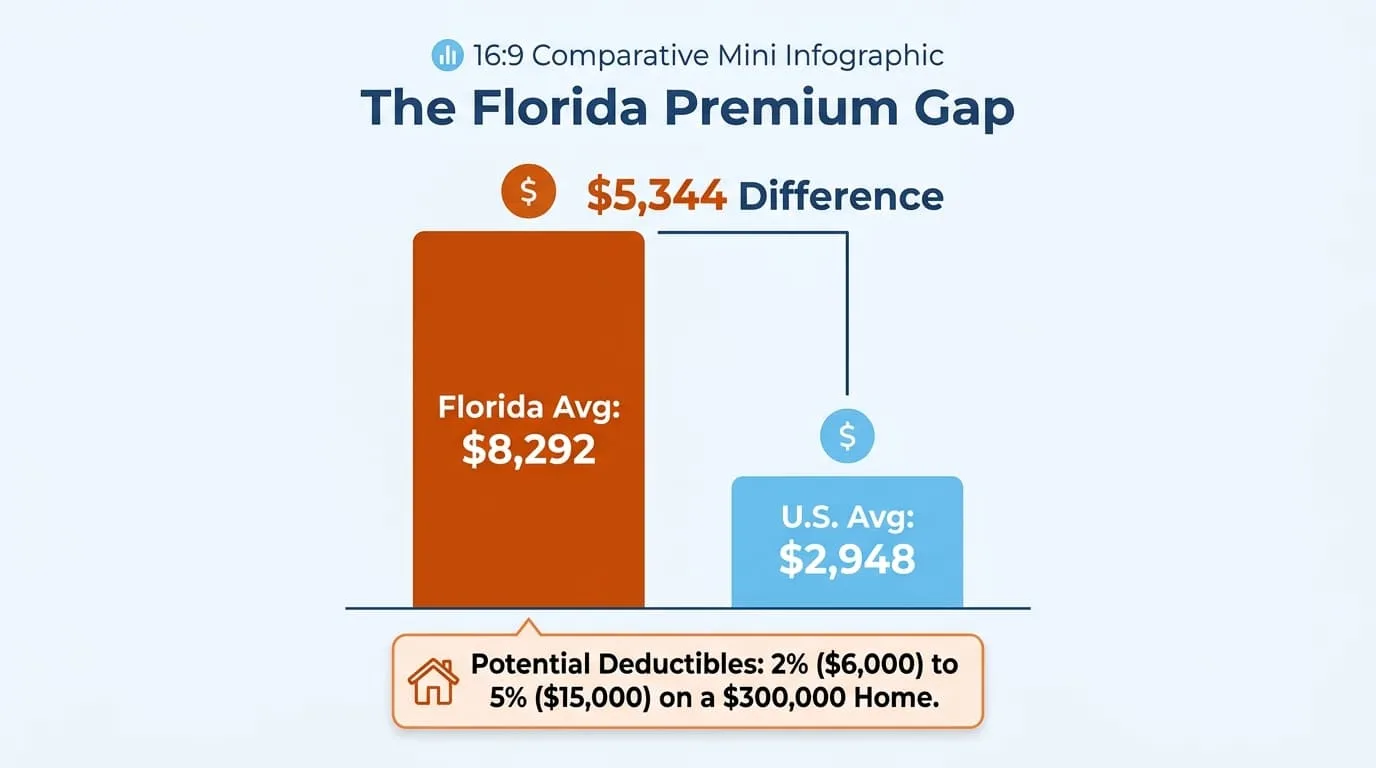
Florida’s $8,292 average premium sits nearly three times the national average of $2,948 in 2025, creating a substantial difference in household insurance costs. Insurify reported both figures in its national pricing analysis.
The gap matters because homeowners may assume that higher premiums mean straightforward claim payments. They do not. Coverage depends on the policy and the facts surrounding the loss. For a roof claim, the financial exposure can involve several separate numbers:
| Insurance or repair measure | Amount |
|---|---|
| Florida average annual premium | $8,292 |
| U.S. average annual premium | $2,948 |
| Difference | $5,344 |
| Potential 2% deductible on $300,000 | $6,000 |
| Potential 5% deductible on $300,000 | $15,000 |
After a hurricane or severe thunderstorm, a homeowner can have a valid policy, significant roof damage, and a large repair estimate while still facing a substantial deductible or coverage limitation. The Florida Department of Financial Services advises homeowners to review their own policy because forms and coverage provisions differ between companies.
For that reason, ask a roofing contractor for a repair scope rather than a promise about an insurance outcome.
Why did Florida premiums jump 18% from 2024 to 2025?
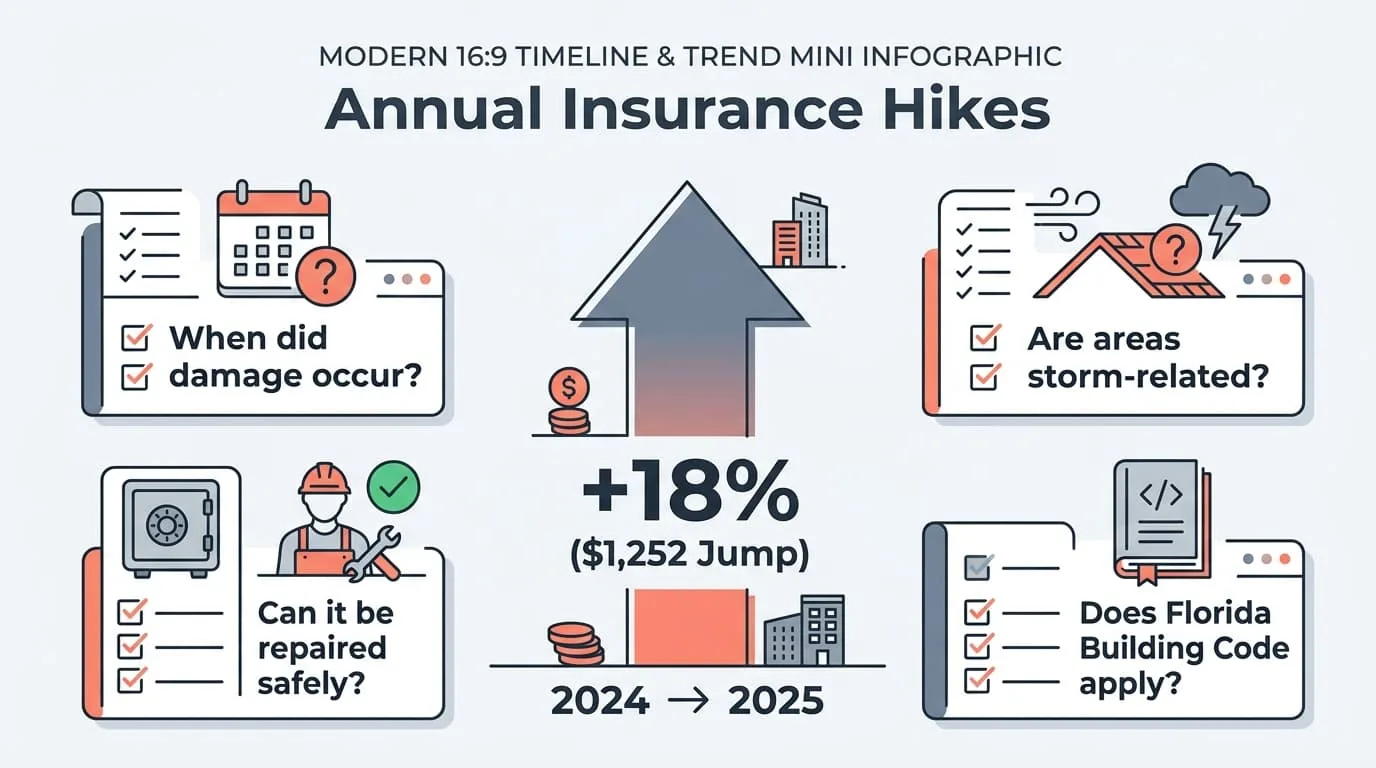
Florida’s average homeowners insurance premium increased 18% from 2024 to 2025, adding $1,252 to the reported annual average. Insurify attributed the increase partly to losses from the 2024 hurricane season and projected another increase for 2026.
For homeowners already concerned about affordability, a roof replacement is a separate financial event, and a hurricane deductible can add thousands of dollars to the amount they must fund. Storm frequency also shapes the broader market. Florida’s coastline, hurricane exposure, property growth, rebuilding costs, and concentration of insured property all affect how insurers evaluate risk.
That does not mean every storm-damaged roof will produce an insurance claim. A contractor should first establish whether there is physical damage and what likely caused it. Useful questions include:
- When did the damage likely occur?
- What areas of the roof show storm-related damage?
- What evidence supports that conclusion?
- Can the roof be repaired safely?
- Does Florida code affect the proposed repair?
- What would replacement cost if repair is not appropriate?
If you are searching for a roofer in Lakeland, look for one that offers inspections, roof repair in Lakeland, replacements, emergency tarping, and photo documentation. True Roofers provides these services across Central Florida, and the Lakeland team serves homeowners throughout Polk County and surrounding communities.
Why did 40.3% of Florida private-insurer claims close without payment?
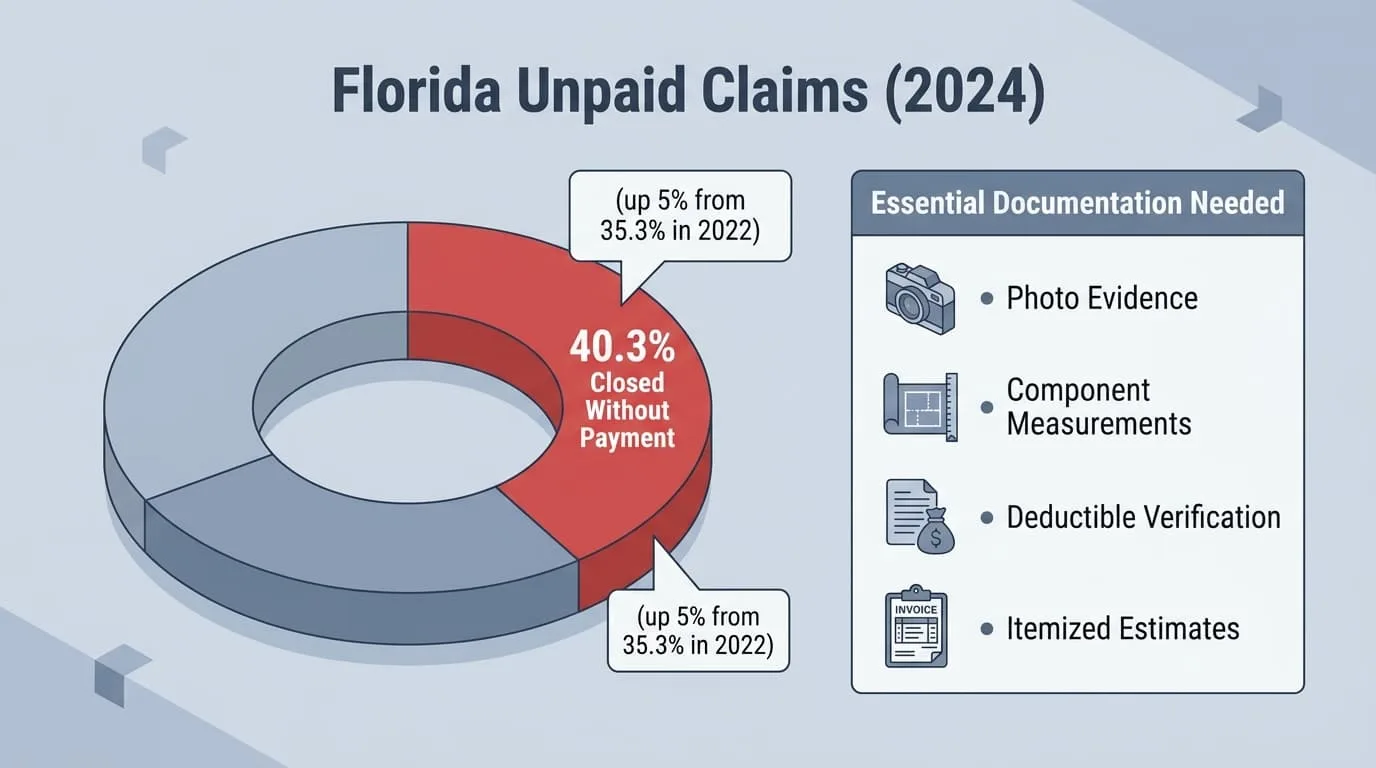
Claims Journal reported that 40.3% of claims at private home insurers in Florida closed without payment in 2024, up five percentage points from 35.3% in 2022. The statistic describes claim outcomes, not the merits of individual claims.
A claim closed without payment does not automatically mean an insurer acted improperly or that the homeowner lacked legitimate damage. Claims can close for reasons involving coverage, deductibles, exclusions, documentation, causation, or the value of the covered loss. Still, the number helps explain why documentation has become so central to the Florida roofing conversation.
The National Association of Insurance Commissioners (NAIC) provides the standardized insurance reporting data that analysts use to compare claim activity, including the Weiss Ratings analysis cited in Florida market reporting.
For a storm-damaged roof, a strong file connects the physical condition of the property to the reported event. Photographs, inspection notes, measurements, affected materials, temporary repair records, and a clear estimate can all matter. Florida’s Department of Financial Services tells homeowners to photograph damage before temporary repairs when possible, keep receipts, notify the insurer, and cooperate with the insurer’s investigation.
The process divides naturally: the roofer documents the roof, the homeowner reports the loss, and the insurer evaluates coverage. Ask your roofing contractor:
- Will you provide a written inspection report?
- Will the report identify each damaged roof component?
- Will you photograph the affected areas?
- Will you separate storm damage from ordinary wear and deterioration?
- Will you provide an itemized repair or replacement estimate?
The last question matters because the Department of Financial Services says an itemized invoice should accompany a claim or supplemental claim when appropriate, allowing the insurer to verify costs and coverage.
Why were 45% of surveyed Florida homeowners’ recent claims initially denied?
A July 2026 University of North Florida poll found that 45% of surveyed homeowners who had filed a claim in the previous five years said it was initially denied. The result came from 261 respondents who reported filing homeowners insurance claims.
This is narrower than saying 45% of all Florida roof claims are denied. It measures what surveyed homeowners reported about their own claims. The UNF Public Opinion Research Lab conducted the broader survey among 1,511 Florida homeowners with property insurance from July 16 through July 31, 2026, with a margin of error of ±3.18 percentage points.
An initial denial is not necessarily the final outcome. A homeowner may provide additional documentation, request reconsideration, receive a partial payment, or pursue another available dispute process. The initial inspection can shape the quality of the file, so a contractor should document the observed condition without overstating what the evidence proves.
A practical conversation with a roofing contractor should cover:
- Cause: What evidence suggests wind, hail, debris, or another cause?
- Condition: Which roof components are physically damaged?
- Scope: Is repair technically appropriate, or is replacement required?
- Code: Are Florida Building Code requirements relevant?
- Documentation: What photos, measurements, and written findings will be supplied?
- Cost: What is the itemized estimate for the recommended work?
That approach keeps the contractor focused on the roof itself while giving the homeowner a clearer record for the insurance process.
Why are 63% of Florida homeowners more concerned about insurance than property taxes?
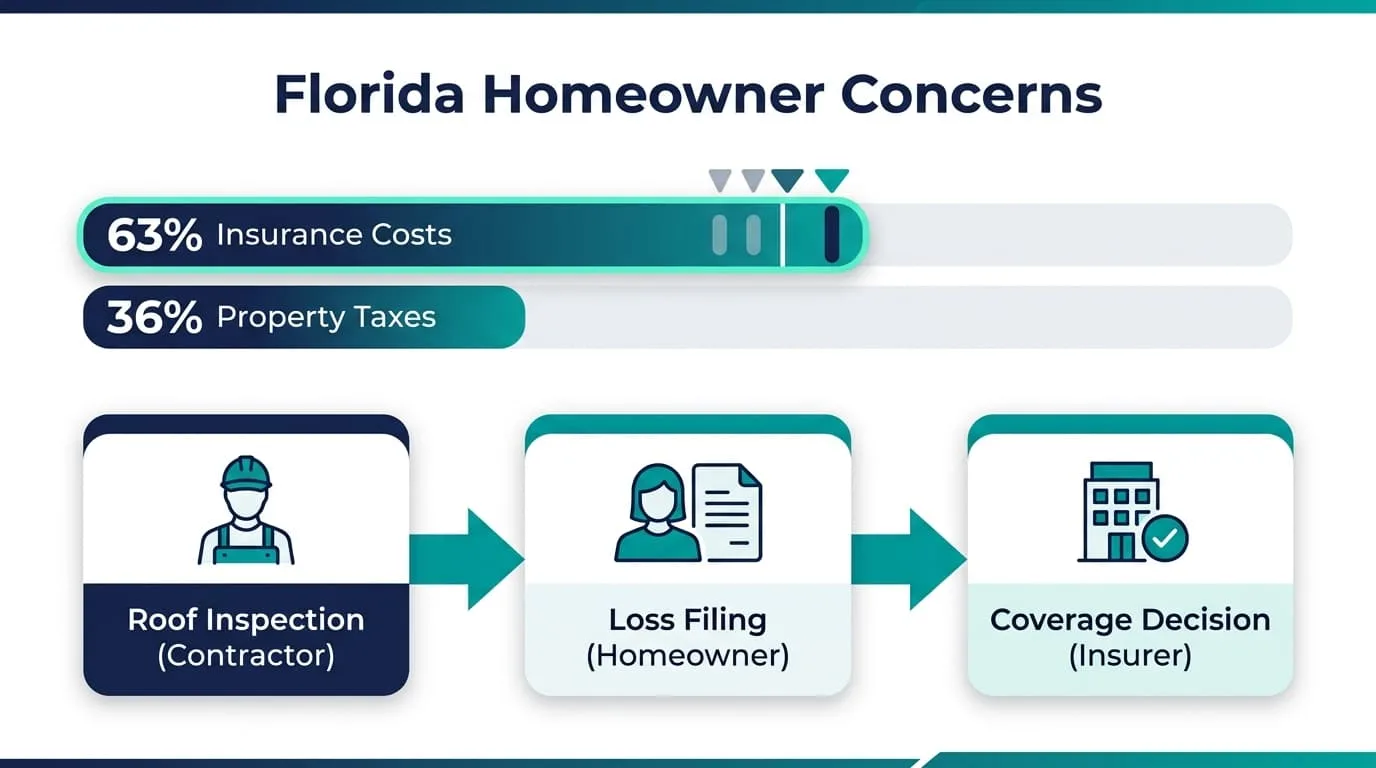
Insurance was a greater concern than property taxes for 63% of surveyed Florida homeowners, compared with 36% who named property taxes. The July 2026 UNF Public Opinion Research Lab poll surveyed 1,511 Florida homeowners.
The 27-percentage-point difference shows how insurance has become part of the household-cost conversation. Premiums, deductibles, non-renewal concerns, and uncertainty about claims all affect how homeowners approach major repairs. The finding does not mean every homeowner faces the same problem, but it shows insurance is a prominent concern among those surveyed.
After a storm, homeowners should separate three questions:
- What happened to the roof?
- What will the repair or replacement cost?
- What does the insurance policy cover?
Those questions may involve a roofing contractor, an insurance carrier, a licensed adjuster, and, when appropriate, a public adjuster or attorney. Florida’s Department of Financial Services explains that company adjusters work for insurers, while public adjusters represent policyholders and generally charge a percentage of the claim settlement.
A roofing contractor can inspect and document physical damage without deciding whether the policy covers it. True Roofers photographs damage and provides a written condition report. The homeowner files the claim with the carrier.
Why were there 129 Florida lawsuits per 1,000 denied claims versus about 11 nationally?
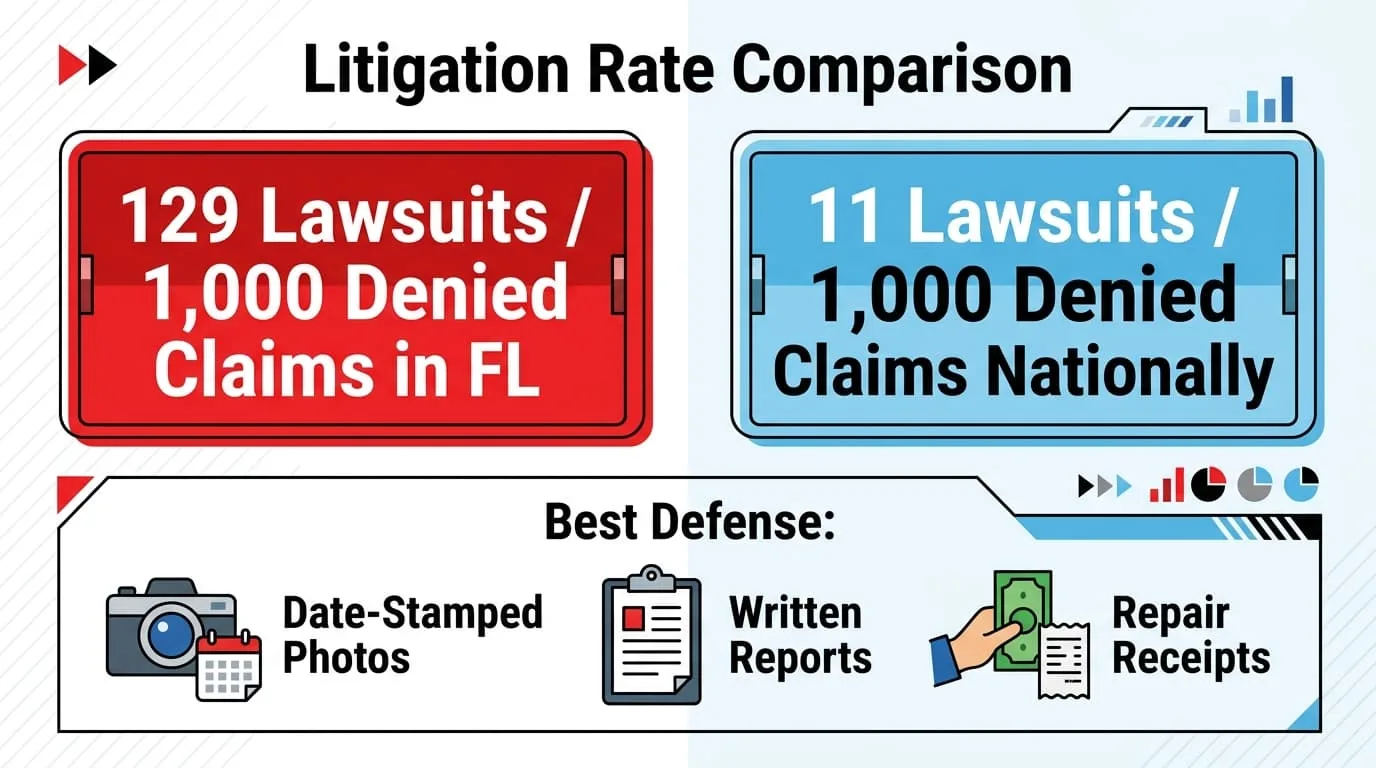
Weiss Ratings’ analysis of NAIC data reported 129 lawsuits per 1,000 denied claims in Florida compared with approximately 11 per 1,000 nationally. These figures describe litigation associated with denied claims and are not evidence about the merits of individual lawsuits.
The difference is large enough to explain why Florida’s property insurance market draws close attention from insurers, regulators, contractors, homeowners, and legal professionals. A disputed roof claim can involve several separate disagreements: the cause of damage, the repair scope, or the cost of restoring the property. A lawsuit count cannot establish whether an insurer improperly denied a claim or whether a claim lacked coverage. Those questions require examining the policy, evidence, damage, communications, and applicable law.
For homeowners, the practical response is better documentation. A useful storm-damage file should include:
- Date-stamped roof photographs
- Written inspection findings
- Measurements and affected roof areas
- Temporary repair invoices
- Copies of estimates
- Insurance correspondence
- Weather information when relevant
- Photographs showing interior water intrusion
- Records of previous roof repairs or inspections
That gives the homeowner a factual record before opinions about coverage enter the discussion. True Roofers documents storm damage in photographs and writing during its Lakeland inspections.
Why did Florida’s lawsuit rate increase 15% from 124 to 143 per 1,000?
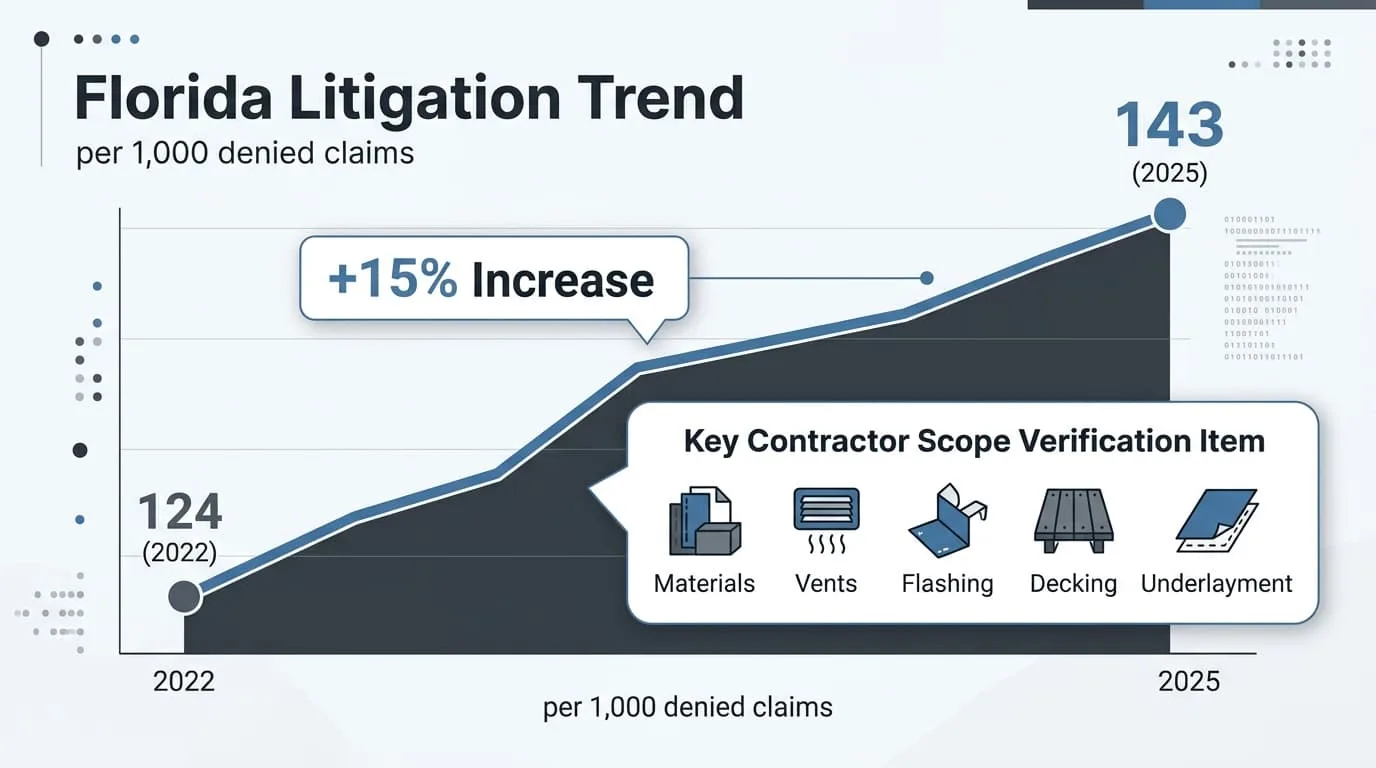
Weiss Ratings data shows Florida lawsuits per 1,000 denied claims rising 15%, from 124 in 2022 to 143 in 2025.
The trend is relevant to the broader discussion of Florida insurance reform, but it should be read with care. Florida’s 2023 tort reforms changed the insurance litigation framework, yet a statistical increase after a law change does not prove the law caused it. The figure also reflects the measurement and reporting period used, so it should not be blended with figures from other years.
The broader point holds: Florida roof claims can become disputes when the parties disagree about cause, scope, coverage, or repair cost. A roofing contractor can help establish the physical side of the dispute by identifying damaged shingles, tiles, flashing, vents, decking, underlayment, or other components and documenting their condition. Homeowners can then ask:
- Does the estimate identify every affected component?
- Does the contractor explain why each repair is necessary?
- Does the estimate separate emergency work from permanent work?
- Are code-related requirements identified separately?
- Does the proposed scope match the physical inspection?
This is where a thorough roof damage assessment differs from a quick visual check from the driveway. True Roofers’ inspection can include the roof and attic when access is available, with photographs documenting what the crew finds.
Why can Central Florida roof replacement cost $8,000 to $30,000?
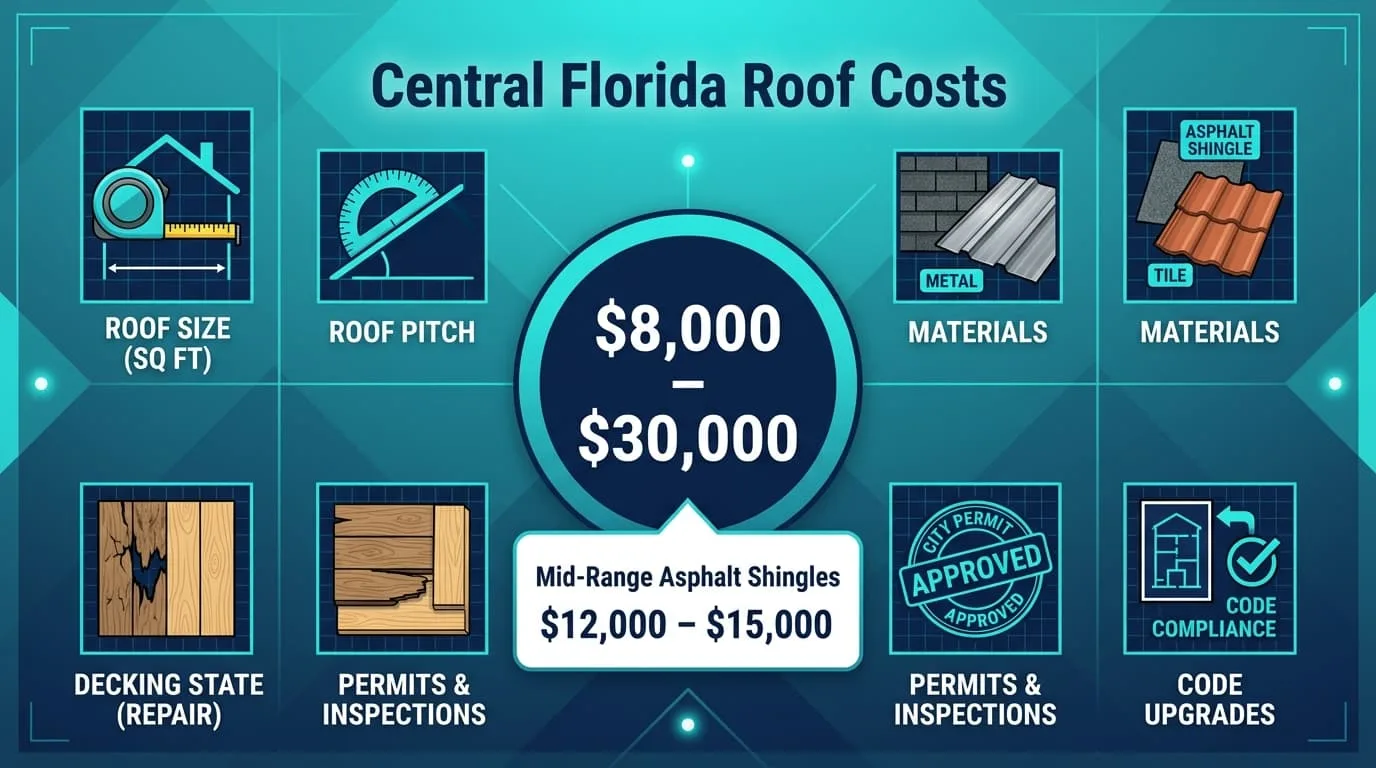
Central Florida roof replacement can range from $8,000 to $30,000, with mid-range asphalt shingle projects commonly estimated at $12,000 to $15,000. This pricing comes from a licensed Central Florida contractor, so treat it as directional market information rather than an official statewide price index.
Pricing varies because no two projects are identical. Roof size, pitch, material, decking condition, flashing, ventilation, accessibility, labor, tear-off requirements, and code requirements all affect the final estimate.
The difference between a contractor’s estimate and an insurance payment creates the practical repair gap. A homeowner may receive a repair scope that differs from the insurer’s estimate because the parties measured different quantities or interpreted the damage differently. A contractor should explain the estimate in physical terms rather than just presenting a total:
| Roof question | Why it matters |
|---|---|
| What material is damaged? | Establishes the appropriate repair method |
| How much area is affected? | Determines labor and material quantities |
| Can matching materials be obtained? | May affect repair feasibility |
| Is decking damaged? | Can add structural repair costs |
| Are flashing and penetrations affected? | These areas can contribute to leaks |
| Are permits required? | Code compliance can affect project scope |
| Is full replacement necessary? | Determines whether repair or replacement is appropriate |
For a Lakeland homeowner, the useful question is not “How much is a new roof?” but “What physical work does this estimate include, and why?” Central Florida shingle replacement costs vary significantly. An estimate should be based on the actual property rather than a generic square-foot figure.
Why can a Florida hurricane deductible reach $6,000 to $15,000 on a $300,000 home?
A 2% to 5% hurricane deductible on a $300,000 insured dwelling equals $6,000 to $15,000 before the insurer pays covered hurricane losses. Florida’s Department of Financial Services confirms that policies for dwellings of $250,000 or more must offer 2%, 5%, or 10% hurricane-deductible options, subject to statutory rules and policy details.
The calculation is simple:
- 2% x $300,000 = $6,000
- 5% x $300,000 = $15,000
A deductible is not the same as a denied claim. It is the policyholder’s share of a covered loss before the insurer pays according to the policy. The Department of Financial Services advises homeowners to find the hurricane deductible on the policy’s declarations page and understand the amount before a storm occurs.
A homeowner can have substantial covered roof damage and still need to fund a large deductible. The actual policy controls, and Florida law includes exceptions and special rules for different insured-value ranges. Ask your insurance agent:
- What is my hurricane deductible?
- Is it a percentage or a fixed dollar amount?
- What insured value is used to calculate it?
- Does it apply annually or separately under my policy?
- Do I have a separate roof deductible?
- Which deductible applies to this specific storm?
A roofing contractor should not be expected to interpret policy coverage in place of the insurer or a licensed insurance professional. True Roofers can document the physical roof condition and prepare a repair or replacement estimate. We do not act as a public adjuster, and we do not file claims.
What should Lakeland homeowners ask a roofing contractor after storm damage?
Lakeland homeowners should ask for evidence, licensing information, a written scope of work, repair-versus-replacement reasoning, and a clear explanation of what the inspection found. If you are searching for a roofing contractor in Lakeland, ask these questions before you sign.
- “What exactly did you find?” A qualified roofing contractor in Lakeland should identify the affected roof materials and explain the observable evidence, without vague claims that a storm destroyed the roof.
- “Why does this require repair or replacement?” A small area of repairable damage is different from widespread damage, compromised decking, repeated leaks, or components that cannot be restored safely.
- “What documentation will I receive?” Ask whether the contractor provides photographs, measurements, a written report, and an itemized estimate.
- “Are you a licensed roofing contractor in Florida?” Ask for the license number and verify it. A roofing contractor license has specific limits on what work it covers. What a roofing contractor license covers in Lakeland is the local version of that question. True Roofers lists Florida roofing license CCC1332725 and maintains a Lakeland office at 2829 Badger Road #19.
- “Who handles the insurance claim?” Contractor and public-adjuster responsibilities are different. Homeowners file the claim with their carrier. True Roofers supplies photographs and a written condition report. A licensed public adjuster, by contrast, represents the homeowner in the claim process.
You can also ask any contractor for:
- Florida license number
- Proof of insurance
- Written estimate
- Material manufacturer and product line
- Expected project timeline
- Permit responsibility
- Warranty information
- Emergency repair plan
- Documentation of storm damage
What should homeowners ask about roof age and pre-existing damage?
Ask the contractor to distinguish storm-related damage from age-related deterioration, because insurers may treat those conditions differently.
Roof age can matter after a storm because shingles, tiles, flashing, seal strips, underlayment, and other components deteriorate naturally. That does not mean an older roof cannot sustain covered storm damage. It means the inspection should accurately describe what is visible and avoid treating every defect as storm-related. Lakeland inspections can document a roof’s condition and identify remaining useful life when age is an issue.
Ask:
- How old is the roof according to available records?
- What condition was it in before the storm?
- What damage appears new?
- What damage appears consistent with age?
- Are there previous repair records?
- Does the inspection identify pre-existing conditions separately?
- Is there attic evidence of an older leak?
This documentation is also useful when an insurer requests a roof inspection for insurance, and it creates a clearer record if the insurer later asks about pre-existing damage.
What should homeowners ask after a roof claim is denied or underpaid?
After a denial or disputed payment, first compare the insurer’s written position with the contractor’s documented findings and the actual policy language.
A denial does not automatically mean the insurer is wrong, and a contractor’s assertion that every observed defect should be covered is not automatic either. Start with the evidence. Request the insurer’s explanation in writing and compare it with the roofing inspection, photographs, estimate, and policy provisions. The Florida Department of Financial Services provides consumer assistance for insurance questions and complaints, including a toll-free Insurance Consumer Helpline.
A basic review can look like this:
| Question | Contractor record | Insurance record |
|---|---|---|
| What caused the damage? | Inspection findings | Coverage determination |
| What is damaged? | Photos and measurements | Adjuster's estimate |
| What must be repaired? | Scope of work | Covered scope |
| What will it cost? | Contractor estimate | Carrier estimate |
| What does the policy cover? | Contractor may not decide | Insurer and policy language |
| What happens next? | Repair plan | Claim review or dispute process |
If the disagreement continues, homeowners may consider the options available under their policy and Florida law, which can include reinspection, supplemental documentation, mediation, appraisal, public adjustment, or legal advice. The right path depends on the policy and facts, and no contractor should promise that any dispute method will produce payment.
FAQ
What should Florida homeowners check before hiring a roofing contractor for an insurance claim?
Ask for the license number and confirm it with the state. Ask for a written inspection that separates storm damage from ordinary wear, with photographs, and an itemized estimate that says whether the work is a repair or a replacement. True Roofers documents the roof under license CCC1332725. You file the claim. We do not.
What should I do if my Florida roof claim is denied?
Read the insurer’s written explanation and set it next to the inspection photos, the written findings, and the estimate. A denial can cite wear and tear, pre-existing damage, a policy exclusion, or a thin file. If the dispute continues, the Florida Department of Financial Services consumer helpline is one place to ask which options your policy actually offers. A contractor should not promise that a dispute path will get the claim paid.
How can I document storm damage before filing a Florida roof claim?
When it is safe to be on the property, photograph damaged shingles, tiles, flashing, vents, and any interior stain before cleanup. Keep the inspection report, repair estimates, weather notes, and contractor messages together. A roof inspection is that file. It is not the claim.
Does roof age affect homeowners insurance coverage in Florida?
It can. Insurers use roof age and condition in underwriting, inspections, and renewal decisions, and the policy controls. An older roof can still have storm damage. Ask the contractor to separate what looks new from what looks like age, in writing.
What should I know about the Florida roof replacement rule and insurance claims?
The 25% roofing rule in Florida is a building-code rule about how much of a damaged roof section has to be brought up to code. It does not by itself decide what the policy pays. Ask the contractor which areas are damaged, which code items apply, and which of those lines are in the written estimate.
What the insurance repair gap means for Lakeland homeowners
For Lakeland homeowners, a storm-damaged roof raises hard questions about repairs, costs, and insurance coverage. A detailed inspection gives you a factual starting point by documenting the damage, the recommended work, and the expected scope. Insurance coverage is a separate matter that depends on your policy and the claim process.
True Roofers, a licensed roofing contractor serving Lakeland and Polk County, provides inspections, emergency roofing services, documentation, and roof repair in Lakeland. Request a roof inspection and start with clear evidence and a defined scope before deciding how to proceed.
Call (813) 800-1800, or the 24/7 inspection line (863) 880-2041 if water is already inside. Lakeland office: (863) 624-6590. 2829 Badger Rd #19, Lakeland.
License CCC1332725. 4.9 stars on Google, 240+ reviews. 12+ years on these roofs. 100,000+ clients served across the True family.