Florida’s post-hurricane contractor crackdown shows why homeowners should verify roofing credentials before signing: a state lawsuit alleges $1 million+ in losses among more than 80 consumers. After hurricanes, urgency can make a damaged roof feel like an emergency business decision. That is exactly when verification matters most. Licensing, written contracts, damage documentation, and careful insurance communication can help homeowners avoid costly mistakes. The following statistics explain the scale of the problem and what Central Florida property owners can do differently.
A shorter version is Roofing Services Central Florida Face Storm Fraud Crisis With $1M+ Losses.
Key statistics on post-hurricane storm chaser and contractor fraud
The supplied data connects storm-chaser activity with insurance uncertainty, contractor licensing, and the size of Florida’s roofing market.
- $1,000,000+ taken from 80+ victims. Florida Attorney General’s Office. The Evolve Construction lawsuit alleges consumers paid more than $1 million for promised work that was unfinished, poorly performed, or never started.
- 60%+ of complainants are seniors. Florida Attorney General’s Office. More than 60% of the consumers who complained in the Evolve case were senior citizens.
- 45% increase from 2020-2024. National Insurance Crime Bureau. The supplied figure indicates a sharp rise in questionable roofing claims during the period.
- 350,000+ residents. Instant Roofer survey. The supplied survey found more than 350,000 Floridians were targeted by disaster scammers in 2024.
- $5,000 to $80,000. Florida Attorney General’s Office. Insurance payments in the cited cases ranged from $5,000 to $80,000 per property.
- 44%. Wall Street Journal. The five largest home insurers collectively closed more than 44% of claims without payment in 2025, up from 36% a decade earlier.
- 428 unlicensed or rogue businesses flagged. IBISWorld. The supplied figure illustrates the contractor-verification challenge in Florida.
- 11 Florida counties. Florida Attorney General’s Office. The cited Evolve complaints came from consumers across 11 Florida counties.
- $9.0 billion. IBISWorld. Florida’s roofing contractor market was valued at approximately $9 billion in the supplied 2026 data.
- 90-180 days. Florida insurance-market data supplied for this campaign. The range illustrates why complicated hurricane and wind claims can take months to resolve.
Why did one Florida storm scam allegedly take $1,000,000+ from 80+ victims?
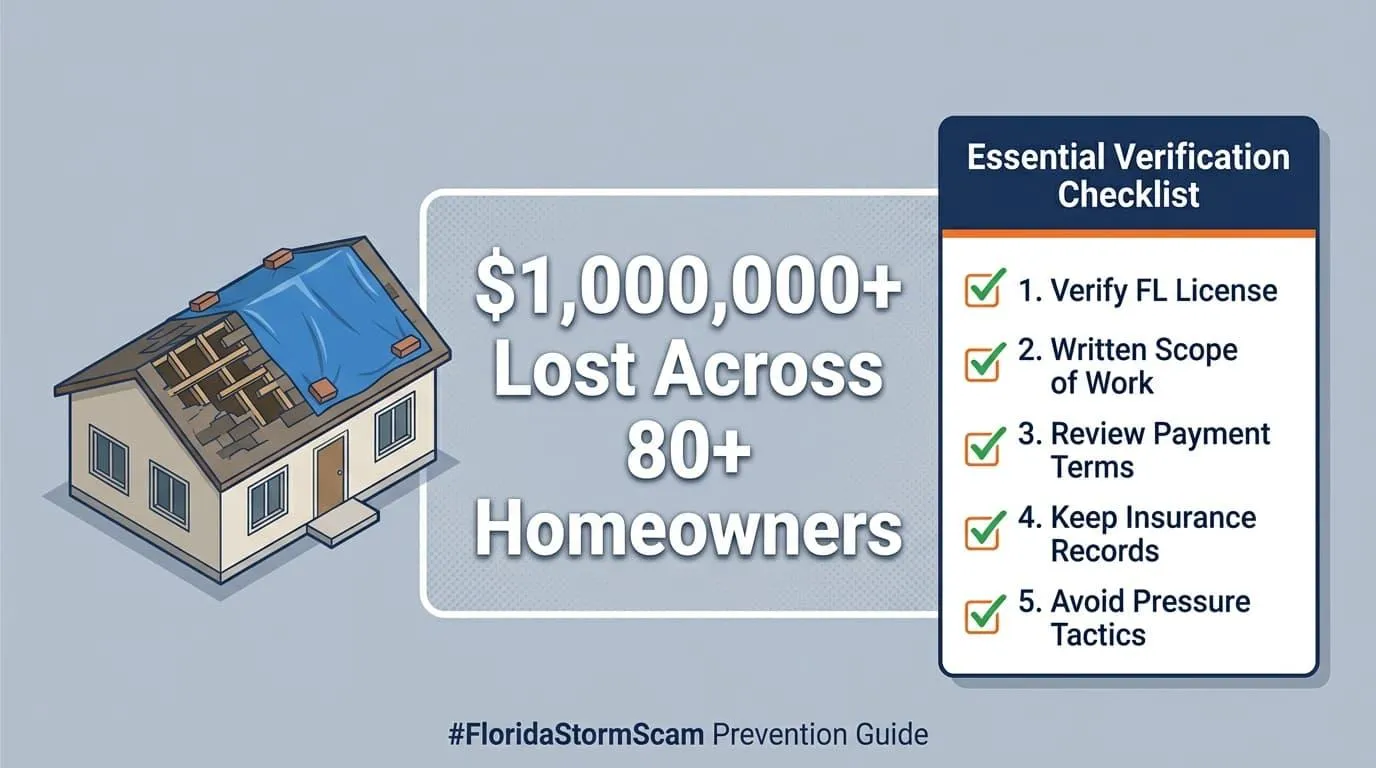
The Evolve Construction lawsuit shows how post-storm roofing fraud can produce losses exceeding $1 million when homeowners surrender insurance proceeds before repairs are completed. The Florida Attorney General’s Office says at least 80 consumers complained and alleged more than $1 million in payments for work they did not receive as promised.
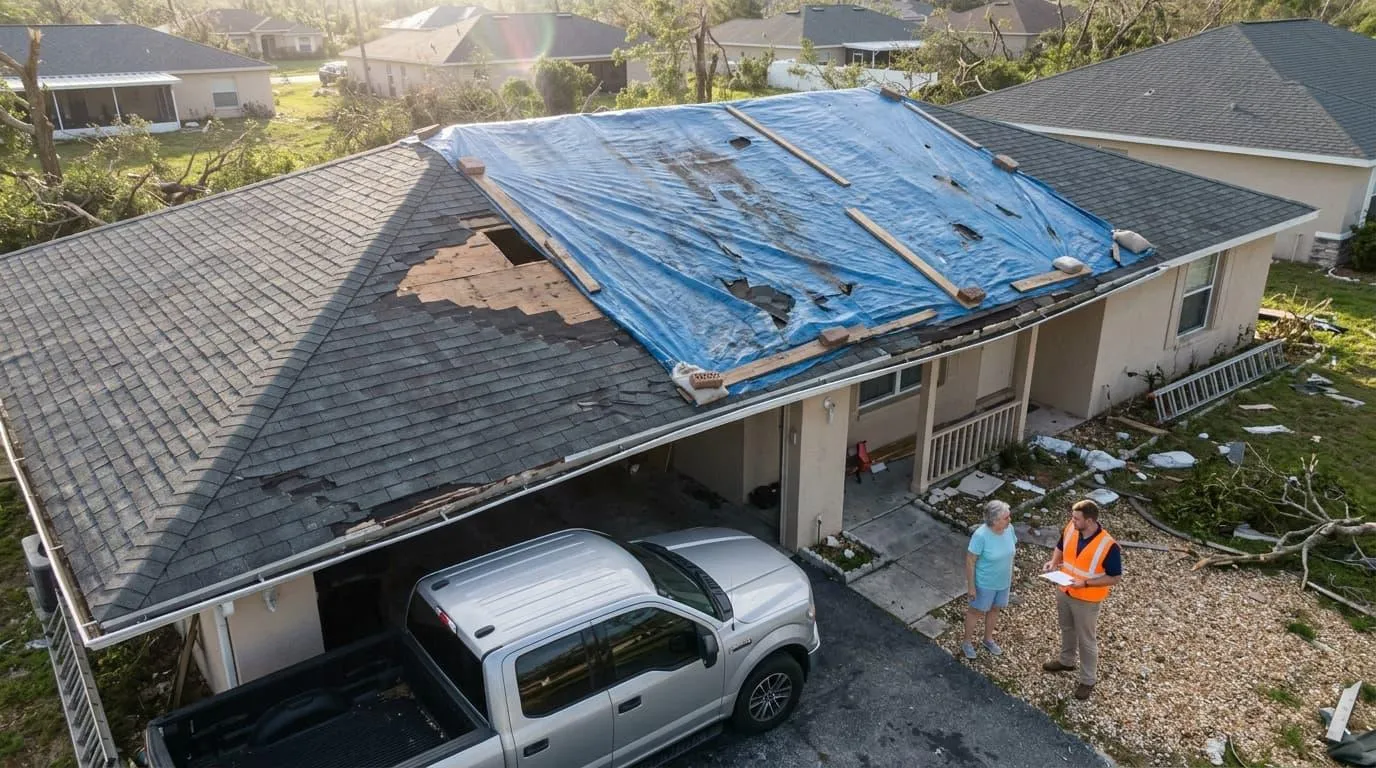
The case involves homeowners seeking roof repair, roof replacement, and water or mold remediation after Hurricanes Ian and Milton. According to the state complaint, representatives went door to door in storm-damaged neighborhoods and offered free inspections.
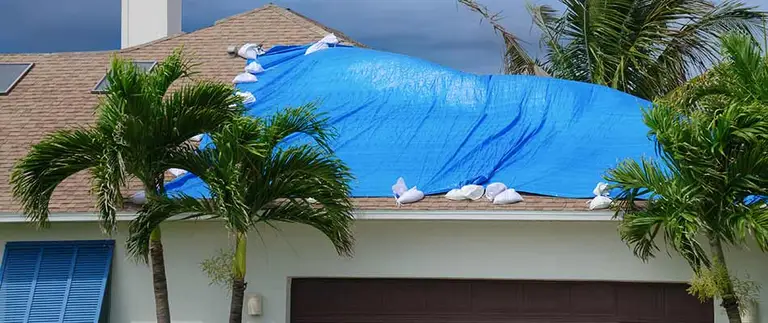
Storm damage creates an unusual sales environment. Homeowners may be looking at exposed decking, missing asphalt shingles, water intrusion, or temporary emergency tarping while several contractors compete for the same work.
The pressure can become stronger when insurance money is involved. A homeowner may assume that receiving an insurance payment means the contractor can immediately collect it. That assumption can create exposure if the contract is unclear or the contractor is not properly verified.
The safer approach is simple:
- Verify the contractor’s Florida license.
- Get the scope of work in writing.
- Review payment requirements carefully.
- Keep copies of insurance correspondence.
- Avoid signing immediately because someone claims the opportunity will disappear.
What makes storm damage different from ordinary roofing work?
Storm damage compresses a normally deliberate roof inspection into a period when thousands of homeowners need repairs simultaneously. That demand attracts established roofing contractors, but it can also attract transient operators.
A legitimate inspection should distinguish storm-created damage from age, deterioration, installation defects, and pre-existing conditions. That distinction matters to both the homeowner and the insurance company.
NICB warns that catastrophe fraud commonly involves contractors traveling into disaster areas, knocking on doors, using high-pressure tactics, and seeking upfront payments.
That is why homeowners should not treat a fast inspection as proof of expertise. Speed can be useful after a hurricane, but documentation and verification are more valuable.
Why were 60%+ of complainants seniors in the cited roofing fraud cases?
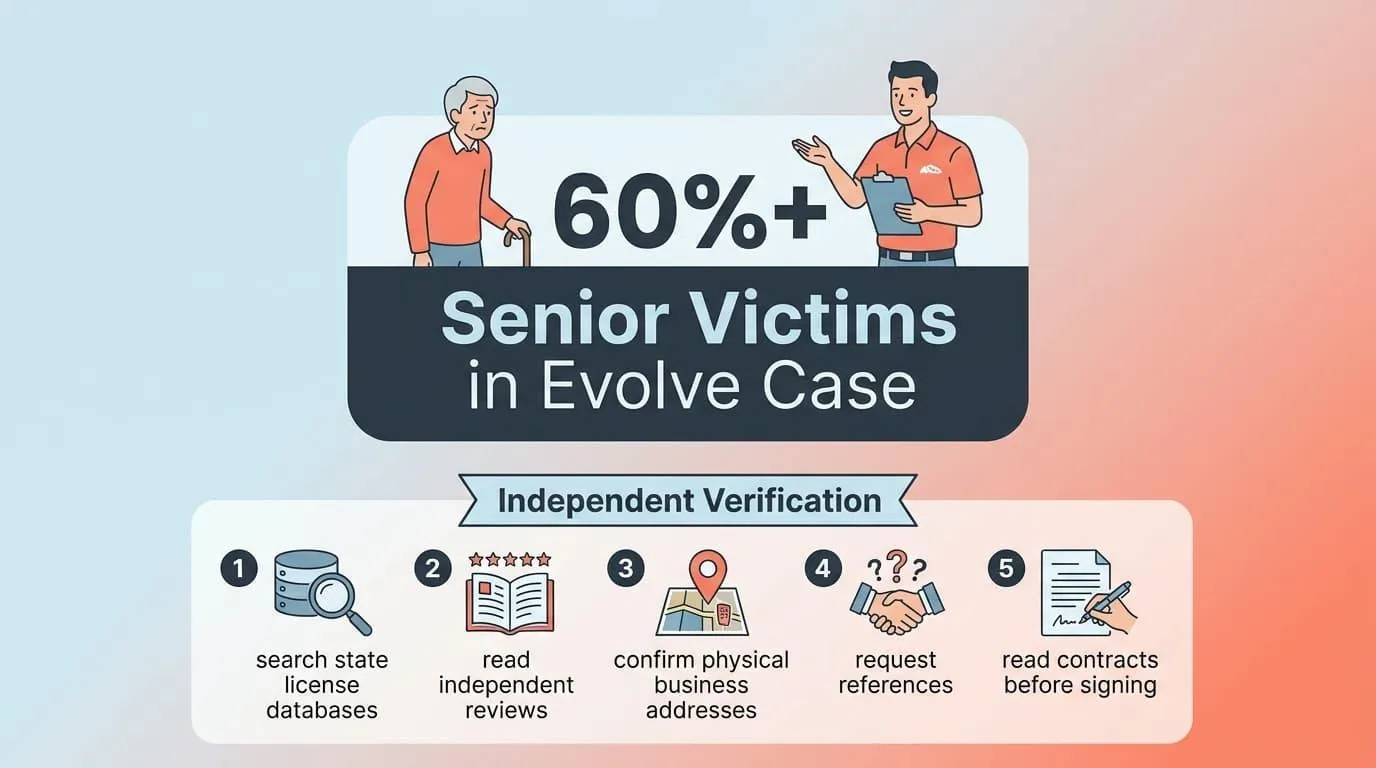
More than 60% of the consumers who complained about Evolve Construction were seniors, according to Florida’s Attorney General, showing how vulnerable homeowners can become a specific target after severe weather.
The statistic matters because storm fraud often begins with personal contact. A representative arrives at a damaged home, offers a free inspection, and presents an immediate solution. For an older homeowner dealing with water damage or a damaged roof, that offer can sound helpful.
NICB has specifically warned that unscrupulous contractors may prey on vulnerable homeowners, including elderly residents, following severe weather.
The strongest defense is independent verification. Homeowners should not rely solely on a salesperson’s badge, business card, vehicle, or branded paperwork.
Useful checks include:
- Verify the license through Florida’s licensing system.
- Search independent customer reviews.
- Confirm a physical business presence.
- Request references.
- Read every contract before signing.
- Never allow pressure to replace due diligence.
Of course, legitimate contractors can also arrive quickly after a hurricane. Fast response itself is not evidence of fraud. The warning signs appear when urgency is combined with missing credentials, vague paperwork, unusual payment demands, or pressure to sign.
Why did questionable roofing claims increase 45% from 2020-2024?
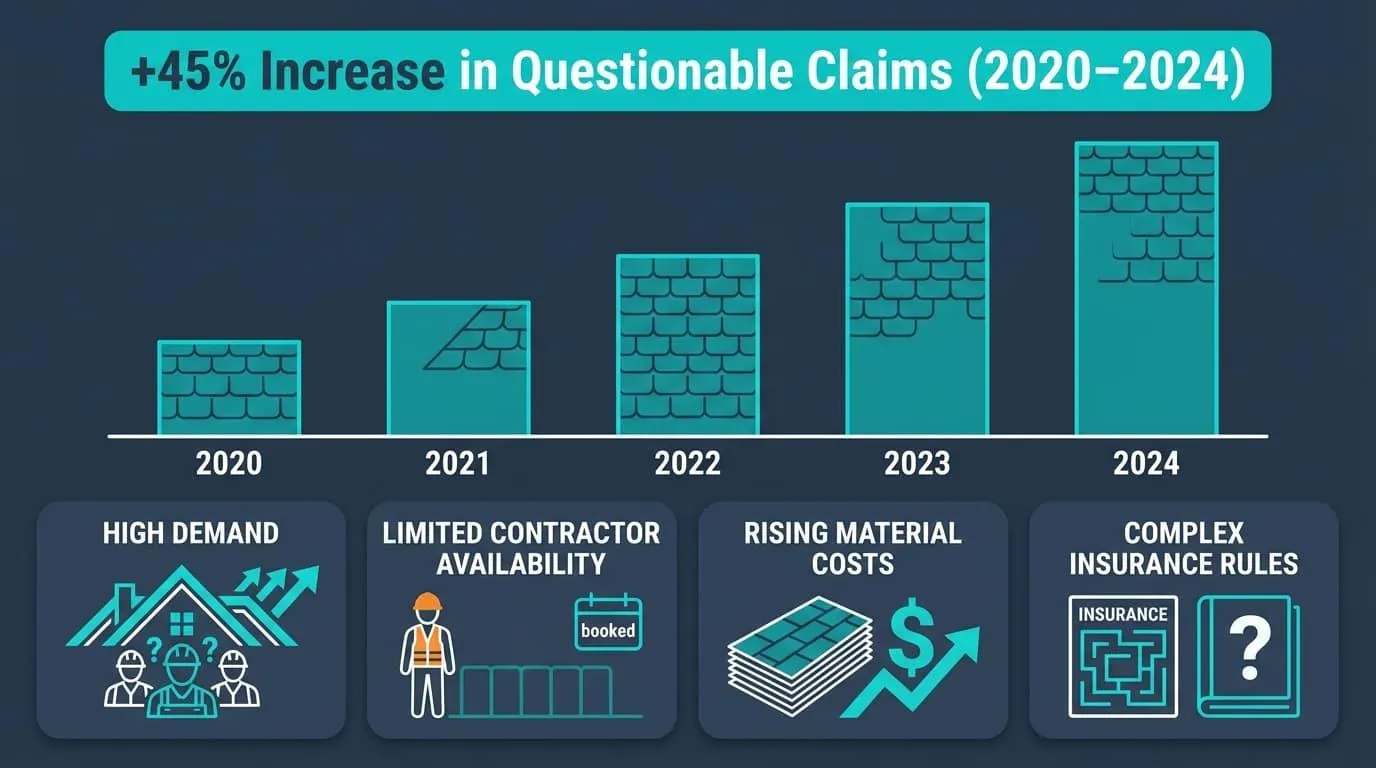
The NICB figure indicates a 45% increase in questionable roofing claims from 2020 through 2024, reflecting a market where severe weather and insurance complexity can create opportunities for fraudulent activity.
NICB’s broader reporting confirms that catastrophe-related contractor fraud remains a recognized problem. Its 2026 materials describe roofing and contractor fraud as a recurring catastrophe-fraud pattern, including door-to-door solicitation and pressure to sign documents.
The underlying incentive is straightforward. A storm produces thousands of damaged properties in a short period. Insurance claims can involve substantial sums, while homeowners may have limited knowledge of roofing materials or damage assessment.
That combination can encourage questionable claims.
Several factors increase the pressure:
- High demand for roof replacement
- Limited contractor availability after major storms
- Rising construction and material costs
- Complicated insurance requirements
- Homeowners unfamiliar with roof-damage indicators
Legitimate roofing companies are affected too. False claims can make insurers more cautious, increase scrutiny, and complicate legitimate insurance claims.
Professional damage documentation therefore protects more than a single homeowner. It helps establish what actually happened to a residential roofing system.
Why were 350,000+ Floridians targeted by disaster scammers in 2024?
The Instant Roofer survey found that more than 350,000 Floridians were targeted by disaster scammers in 2024, illustrating how widespread post-disaster solicitation can become.
The survey covered people displaced by natural disasters, including Hurricanes Helene and Milton. Miami New Times reported that Instant Roofer found scammers targeted more than 350,000 Floridians, with respondents reporting varying levels of scam activity.
The statistic should be treated as survey data rather than a government count. Even so, the scale illustrates why Florida homeowners need a repeatable screening process.
A damaged roof creates an immediate need for roof repair, but homeowners still have time to verify a contractor in most situations. Temporary measures can protect the property while the contractor search continues.
A homeowner can reduce exposure by:
- Photographing damage before repairs when safely possible.
- Covering exposed areas with appropriate temporary protection.
- Contacting the insurer or agent.
- Checking contractor licensing independently.
- Getting written estimates.
- Comparing the proposed scope of work.
This approach is especially useful in Central Florida, where hurricane seasons can create simultaneous demand in Lakeland, Plant City, Winter Haven, Wesley Chapel, Auburndale, and Davenport.
Why do Florida fraud cases involve $5,000 to $80,000 insurance payments?
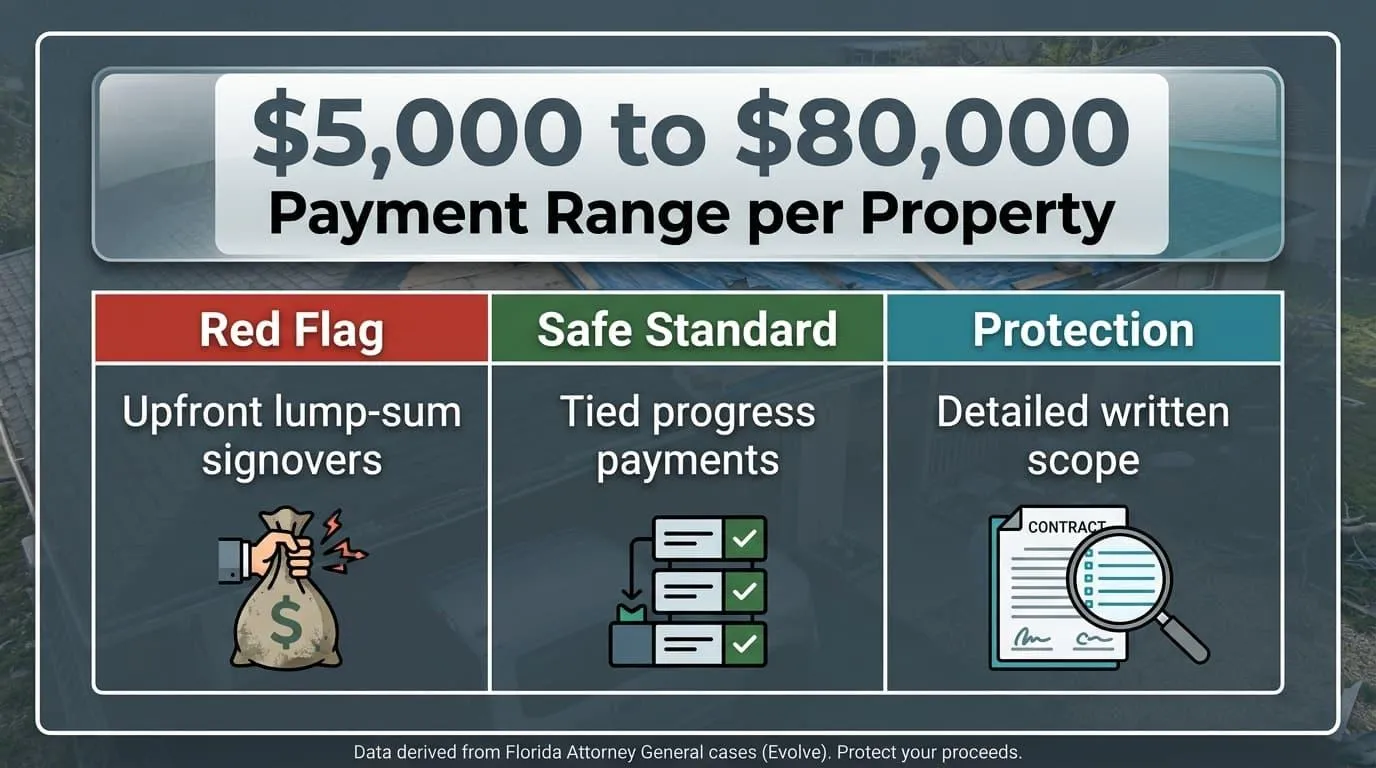
The $5,000 to $80,000 payment range in the cited Florida fraud case shows why insurance proceeds can become attractive targets for dishonest operators. The Florida Attorney General’s complaint says payments in the Evolve cases ranged from $5,000 to $80,000 per property.
Those amounts can represent major portions of a household’s financial recovery after a hurricane. When a homeowner hands over insurance funds before confirming the contractor’s work plan, the financial risk becomes substantial.
The distinction between legitimate payment and fraud is important. Contractors commonly require deposits or staged payments for materials and labor. The warning sign is not simply that money changes hands. The concern is whether the contract, license, scope, payment schedule, and work actually align.
| Data point | What it illustrates |
|---|---|
| $5,000 to $80,000 | Range of insurance payments cited in the Evolve case |
| Storm damage | Creates urgent repair demand |
| Insurance proceeds | Can become a target for fraudulent operators |
| Written scope | Helps establish what the contractor promised |
| Progress payments | Can tie payment to documented work |
A well-documented project gives the homeowner a clearer record of what was inspected, what was damaged, what work was authorized, and what was completed.
That documentation also matters when the project involves metal roofing, tile, flat systems, or other specialized materials. The larger the project, the more important the paper trail becomes.
Why do 44% of home insurance claims result in zero payout?
The Wall Street Journal reported that the five largest U.S. home insurers closed more than 44% of claims without payment in 2025, compared with 36% a decade earlier.
This figure needs careful wording. Zero payout does not necessarily mean a claim was fraudulently denied. The Wall Street Journal’s measure covers claims closed without payment, and industry groups have noted that this category can include claims below deductibles or claims that do not qualify for coverage.
Still, the trend changes the environment for homeowners with legitimate storm damage.
Insurance carriers are dealing with higher repair costs, severe weather losses, changing deductibles, and stricter claim review. Those pressures can make detailed evidence more valuable.
For a homeowner, documentation should establish:
- When the storm occurred.
- What damage appeared afterward.
- What areas of the roof were affected.
- What temporary repairs were performed.
- What the inspection found.
- What repairs or replacements are being proposed.
Professional documentation does not guarantee an insurance payment. It creates a clearer factual record that can help the homeowner, contractor, adjuster, and insurer evaluate the same property condition.
True Roofers photographs the roof and writes down what it sees. We do not file the claim, and we do not adjust it. The insurer decides coverage.
Why were 428 unlicensed or rogue businesses flagged in Florida?
The supplied figure of 428 unlicensed or rogue businesses highlights why Florida homeowners should independently verify contractor credentials before authorizing roofing work. Florida’s Department of Business and Professional Regulation provides a license-verification system and investigates suspected unlicensed activity.
Licensing is not the only screening tool, but it is an important starting point. A legitimate roofing company should be able to provide a license number that homeowners can independently verify.
The name on a sales representative’s shirt is not enough. Neither is a professional-looking contract.
A homeowner should check:
- Florida contractor license status.
- Business identity and address.
- Insurance coverage.
- References and customer reviews.
- Written scope of work.
- Payment schedule.
- Warranty terms.
Florida also provides a process for reporting suspected unlicensed activity. The state’s licensing agency says unlicensed activity can lead to criminal charges when violations are established.
That creates an important distinction between a licensed roofing company and a salesperson who simply claims to represent one.
Why did one roofing fraud scheme span 11 Florida counties?
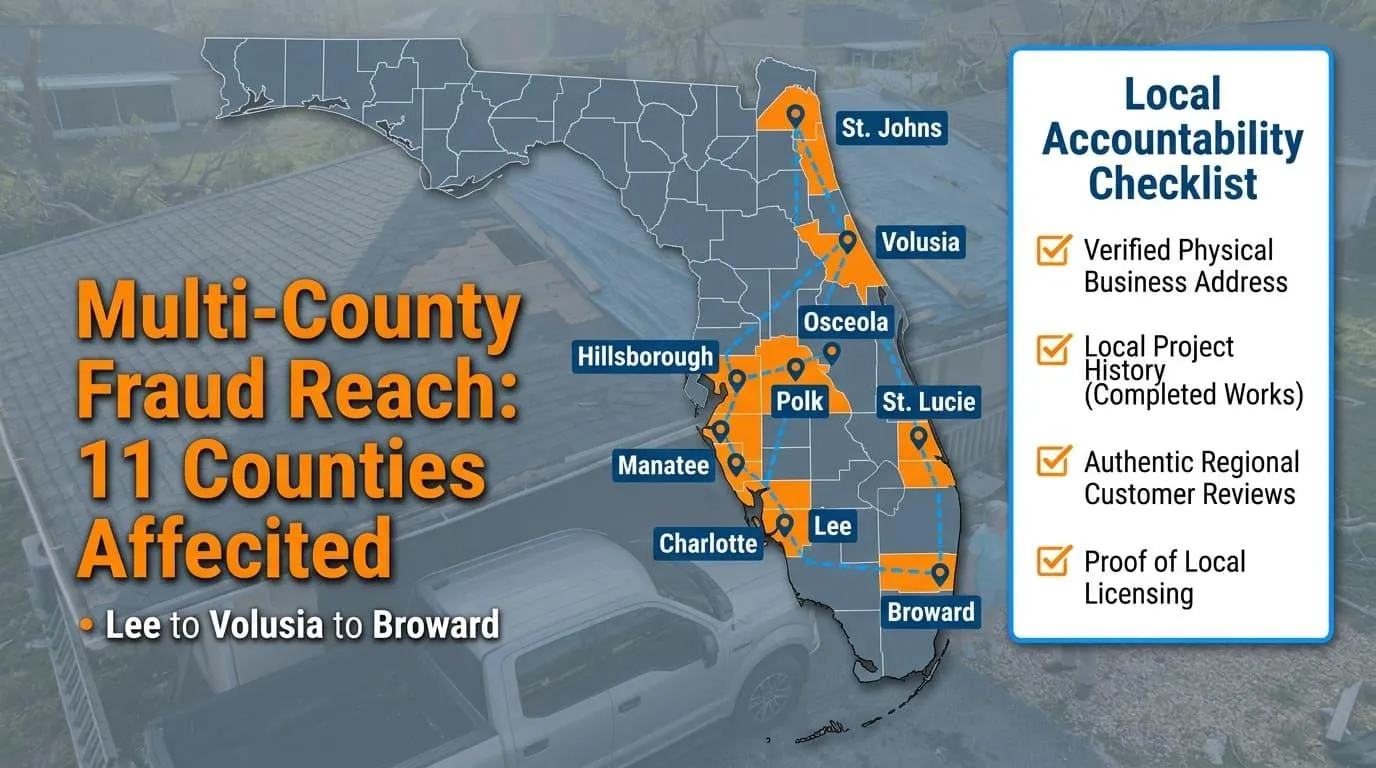
The Evolve case reached 11 Florida counties, showing how storm-related contractor schemes can operate across a wide geographic area rather than remaining inside one neighborhood. The Attorney General’s complaint identifies consumers in counties including Lee, Charlotte, Sarasota, Hillsborough, Polk, Osceola, Manatee, Volusia, St. Lucie, St. Johns, and Broward.
The geographic spread matters for Central Florida homeowners because a company can market across multiple communities while maintaining limited local accountability.
A contractor does not become trustworthy simply because it serves a nearby city. Homeowners should still verify credentials and review the agreement.
Local accountability can help, however. A contractor with established operations, documented projects, customer reviews, and a continuing presence in the community has a stronger reason to protect its reputation.
The screening process remains the same:
- Verify the contractor.
- Confirm the business address.
- Research completed projects.
- Review customer feedback.
- Obtain written terms.
- Keep all claim documents.
That is especially useful when storm restoration involves roof inspections, roof installation, gutters, ventilation, or complete replacement.
Why is Florida’s roofing contractor market worth $9.0 billion?
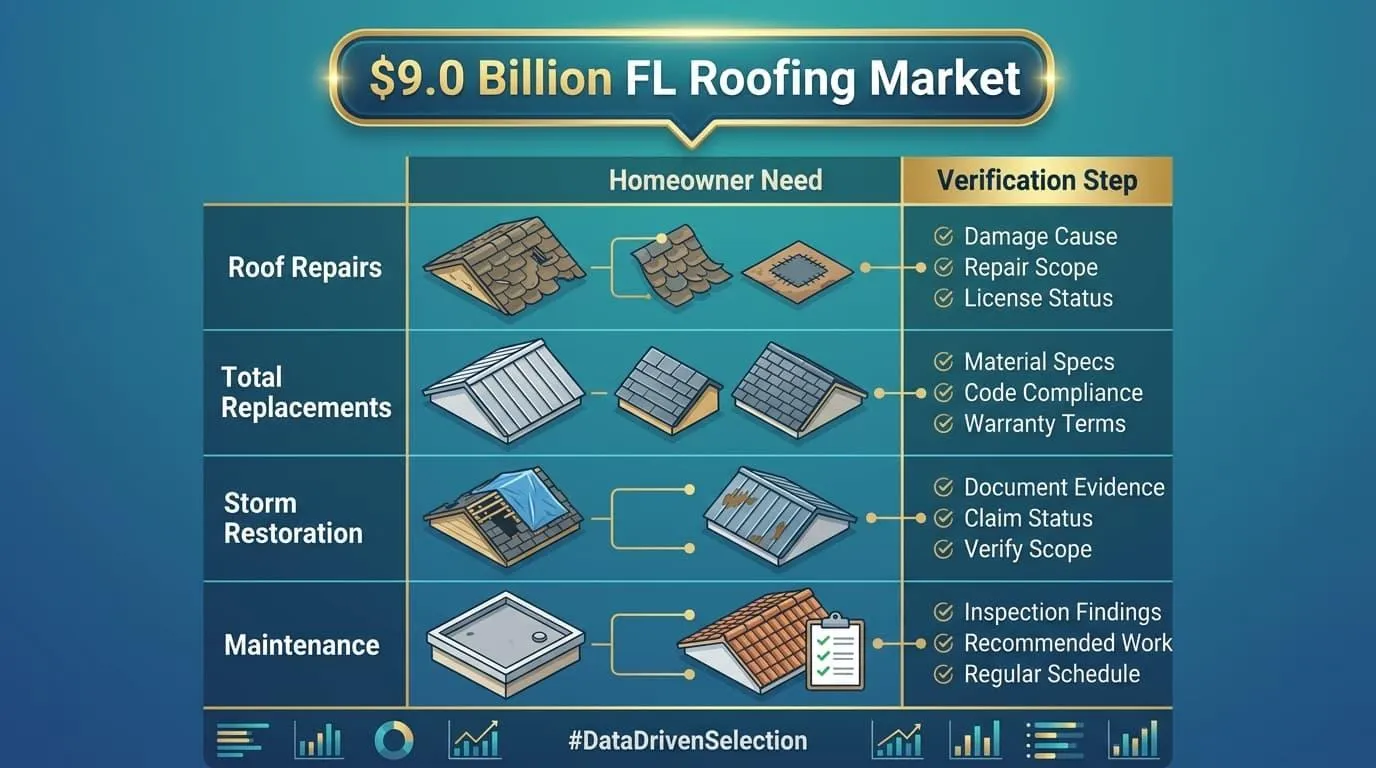
The supplied $9.0 billion estimate shows that Florida has a large and active roofing market, driven by routine replacement, severe weather, construction activity, and ongoing maintenance.
A large market creates legitimate opportunities. It also creates an environment in which questionable operators can attempt to enter quickly after a hurricane.
Florida’s weather creates steady demand for asphalt shingles, metal roofing, tile, modified bitumen, coatings, and other roofing systems. Homes also need preventative maintenance, ventilation work, flashing repairs, and gutter services between major storms.
The market size makes contractor selection more important, not less.
| Homeowner need | What to verify |
|---|---|
| Roof repair | Cause and scope of damage |
| Roof replacement | Materials, code requirements, warranty |
| Storm restoration | Storm-related evidence and documentation |
| Insurance claim | The homeowner's claim records and communication with the insurer |
| Commercial roofing | System specifications and project scope |
| Preventative maintenance | Inspection findings and recommended work |
Florida Building Code requirements also mean roofing work is not simply about placing new materials over an old roof. Installation methods, underlayment, fastening, ventilation, and product approvals can affect performance.
A professional contractor should explain the proposed system clearly rather than using a storm as a reason to rush the homeowner.
Why can hurricane and wind-damage claims take 90-180 days?
The supplied 90-180-day range illustrates why complicated hurricane and wind-damage claims can become lengthy projects involving inspection, documentation, coverage review, estimates, and insurer communication.
The exact timeline varies by claim and carrier. A straightforward repair can move faster, while a disputed or complex claim can take much longer.
Florida’s insurance environment has also become more demanding. The amount of evidence required can increase when the insurer questions the cause, scope, age, or cost of damage.
That makes organization valuable from the first inspection.
Homeowners should maintain:
- Date-of-loss information.
- Roof inspection reports.
- Photographs and videos.
- Written estimates.
- Adjuster correspondence.
- Contractor correspondence.
- Receipts for temporary protection.
- Copies of signed agreements.
The contractor’s role should remain clear. A roofing company can document physical damage. The insurance company makes coverage decisions under the policy. We do not file the claim or speak for the homeowner with the adjuster.
Organized photos and a written scope are the record. They are not a promise that every claim will be approved.
How can Central Florida homeowners avoid storm-chaser fraud?
Central Florida homeowners can reduce storm-chaser risk by verifying licensing, avoiding pressure, documenting damage, and choosing a contractor that remains accountable after the initial inspection.
NICB recommends using licensed and insured contractors, getting more than one estimate, checking references, and putting contract terms in writing. It also warns homeowners not to let contractors pressure them into hiring immediately.
The difference between a storm chaser and a legitimate contractor is not simply where the contractor came from. The better test is whether the company can be independently verified and whether it operates transparently.
| Storm-chaser warning sign | Safer homeowner response |
|---|---|
| Immediate door knocking | Research the company independently |
| "Free inspection" with pressure | Request credentials first |
| No license number | Verify licensing |
| Cash or unusual upfront demand | Review payment terms |
| "Sign today" pressure | Take time to read the agreement |
| Vague damage claims | Request written findings |
| No established local presence | Check address and project history |
| Promise of guaranteed insurance money | Treat the claim decision as the insurer's role |
True Roofers provides roof inspections, roof repair, roof replacement, and storm response, including emergency tarping, throughout Central Florida. Florida roofing license CCC1332725 can be checked on myfloridalicense.com. The company photographs the damage and writes the scope. The homeowner files the claim. The insurer decides what the policy pays.
The service area includes Lakeland, Plant City, Winter Haven, Wesley Chapel, Auburndale, and Davenport. That local presence matters when several neighborhoods need attention after the same storm.
When should I schedule roof inspections in Central Florida?
You should schedule roof inspections before and after major storms, especially during hurricane seasons. An inspection can identify damaged shingles, leaks, and other signs of a roof problem before they become more expensive.
Regular inspections also support preventative roof maintenance and help homeowners determine whether they need roof repair or roof replacement.
How do I know if I need roof repair or roof replacement?
You may need roof repair when the damage is limited to a small area, while widespread storm damage, recurring leaks, or an aging roof may require roof replacement. A qualified roofing professional can inspect your residential roofing system and explain whether repairs can restore the roof or whether replacing it would be more practical.
What should I do if my roof has hurricane damage?
If your roof has hurricane damage, protect exposed areas as soon as possible to prevent additional storm damage. Emergency tarping can provide temporary protection until permanent roof repair is completed.
Take photos of the damage and contact your insurance company if you plan to file a claim. Prompt action can help reduce the risk of further water damage. True Roofers can document the roof. We do not file the claim.
How much do roofing services cost in Central Florida?
Roofing costs depend on the roof size, design, materials, labor, and extent of the required work. Florida market rates can also vary based on demand and Florida weather conditions. Whether you need roof installation, roof repair, or roof replacement, ask roofing contractors for a detailed estimate that explains the materials, labor, project scope, and expected costs.
How can I choose reliable roofing contractors in Central Florida?
Compare roofing contractors based on relevant experience, customer reviews, communication, and knowledge of Florida building codes. Ask whether the contractor uses Florida-rated materials and understands local storm restoration requirements.
You should also review completed local projects and request clear information about pricing, project timelines, warranties, and customer service before choosing a roofing company.
What should homeowners remember about the storm chaser and contractor fraud crackdown?
After a hurricane, you may feel pressure to get your roof fixed quickly, but that doesn’t mean you should skip basic checks. Document the damage, verify the contractor’s license, review the written scope, and understand what you’re signing. Take your time when possible. Urgency should not replace verification.
For Central Florida homeowners, roofing services from True Roofers can be a practical starting point for inspections, repairs, or storm-related roofing needs. A clear inspection and written scope can help you understand what your roof actually needs before work begins. The goal is simple: protect your home while keeping control of the repair decision.